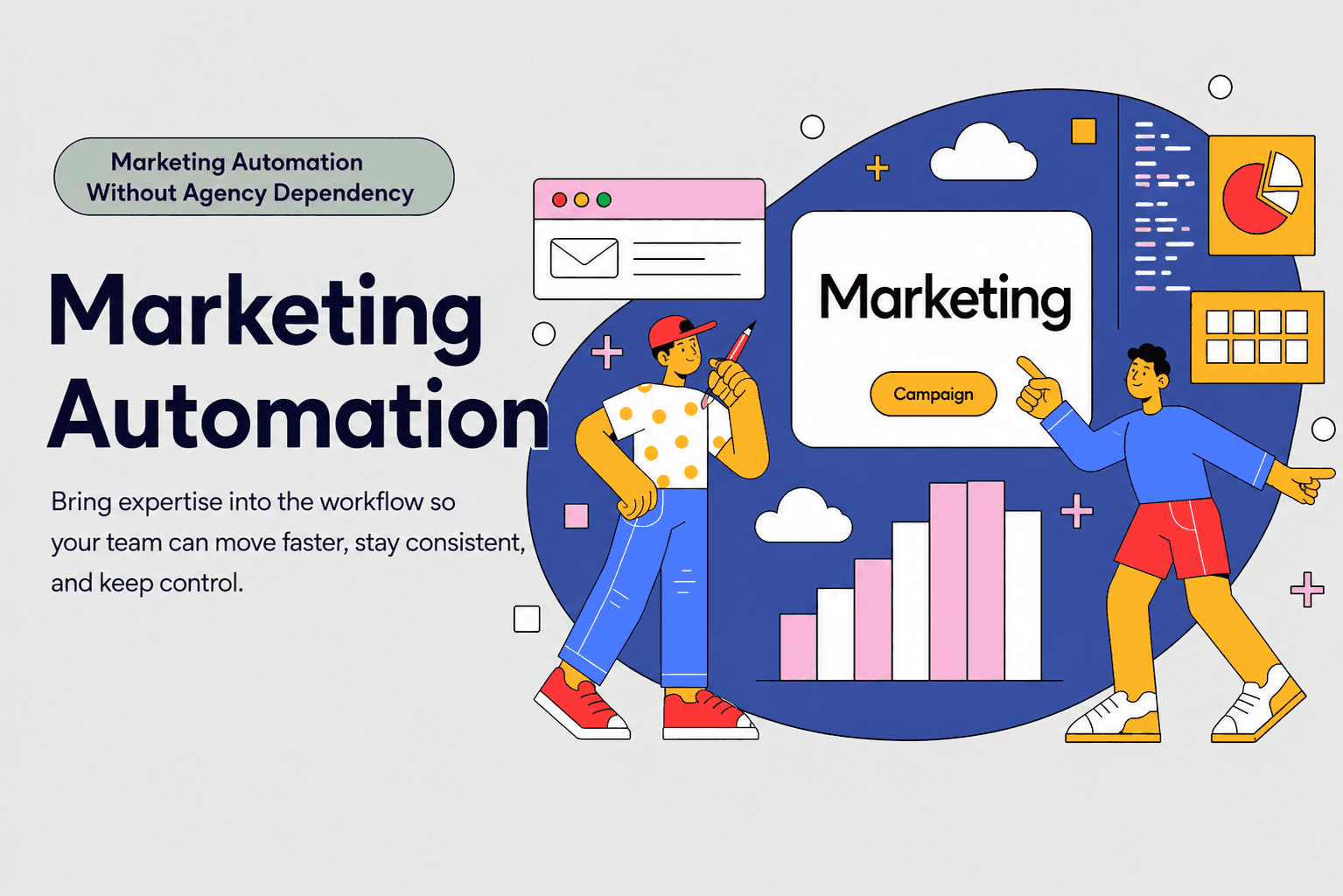
Marketing Automation Without Agency Dependency
Teams can use agencies and consultants strategically without depending on external specialists for every campaign setup question.
Ask AI how this applies to you


Marketing automation is supposed to help teams move faster. In practice, it often creates a new dependency.
Every complex campaign, segmentation question, journey change, data issue, quality assurance step, reporting request, or technical uncertainty gets routed to external specialists. This can happen in Salesforce Marketing Cloud, Adobe, HubSpot, Braze, Klaviyo, Marketo, Iterable, Oracle Eloqua, and almost any other marketing automation platform.
Good agencies and consultants bring valuable experience. The issue is not their skill. The issue is what happens when every operational campaign depends on outside help.
The team waits. Context is transferred again. Decisions are reviewed again. Knowledge stays outside the daily workflow.
Why dependency grows
Agency dependency usually grows gradually.
It starts when internal specialist knowledge is limited. It grows when campaign processes only exist in tickets, old briefs, spreadsheet notes, or the memory of a few people. It becomes stronger when technical decisions are not documented clearly, recurring campaign types are explained from scratch, and time pressure makes external help the fastest short-term option.
At first, this saves time. Later, it can become the default route for almost every operational question.
The pattern is rarely tied to one platform. The names of the tools change, but the operational friction often looks the same: unclear requirements, inconsistent setup, missing documentation, platform-specific logic, local market questions, data uncertainty, and review cycles that take longer than the work itself.
What control really means
Control does not mean every team has to build everything manually.
Control means the team understands what happens, why it happens, and how it can be reviewed or adjusted safely.
In marketing automation, that means campaign logic is understandable, segmentation rules are documented, quality assurance is clear, recurring campaign types follow a standard, and local markets can contribute without breaking central rules.
It also means people remain responsible for final decisions. Automation can support execution, but governance, judgment, approval, and accountability stay with the team.
This becomes even more important when artificial intelligence supports the process. Teams do not want a black box. They want guidance, speed, and consistency while keeping control over what goes live.
Bring expertise into the workflow
Training helps, but it does not solve the full problem.
Marketing automation knowledge is contextual. A tutorial can explain where a feature is located, but a real campaign needs much more: data logic, audience understanding, consent rules, governance, variants, testing, documentation, reporting, and coordination with the actual system.
That knowledge has to be available at the moment work happens.
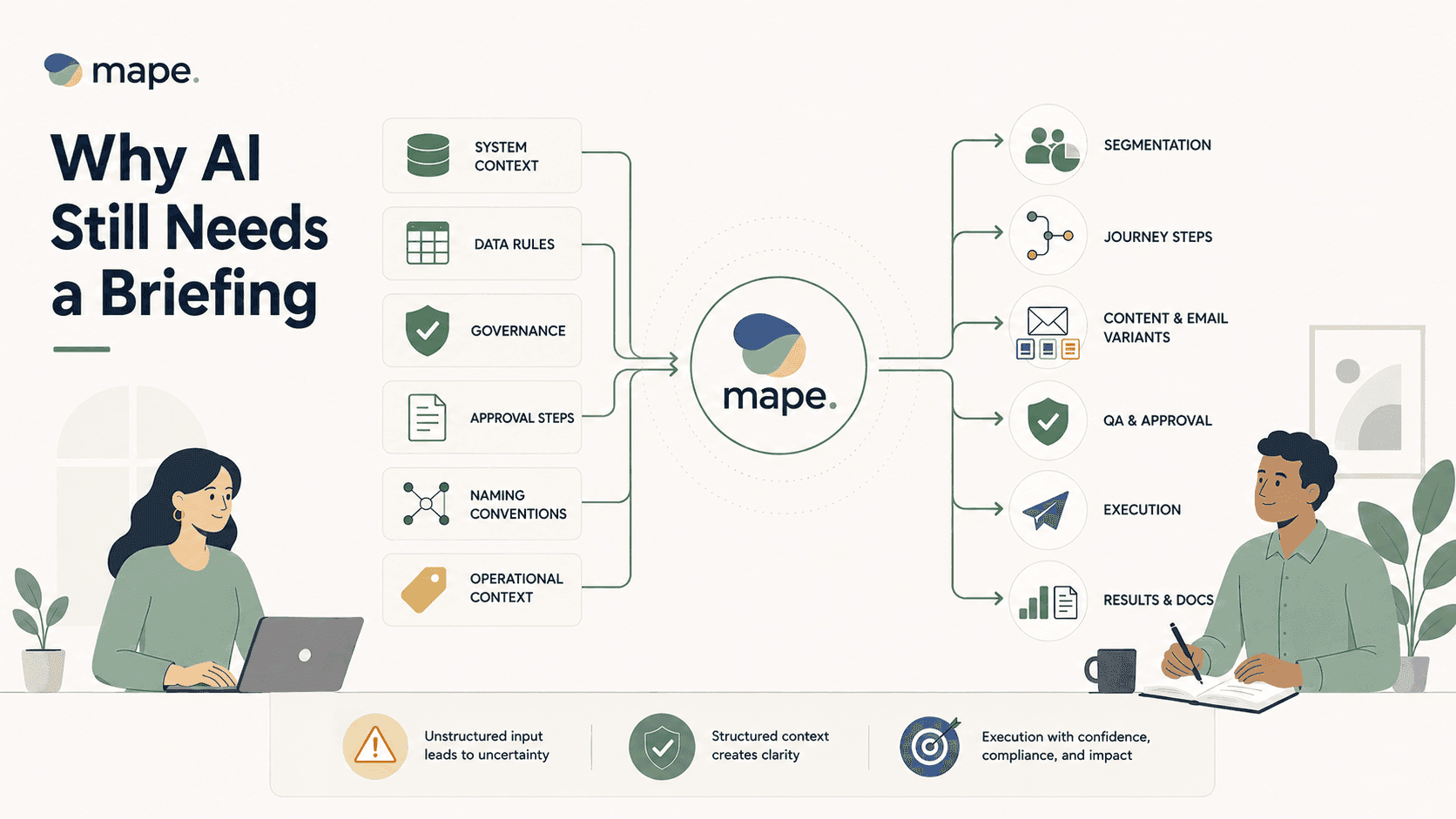
It should support the team when requirements are written, segmentation is defined, journey steps are structured, email variants are prepared, quality assurance is planned, reporting is reviewed, and implementation is documented.
The goal is not to replace human expertise. The goal is to make expertise easier to access during repeatable work, so teams do not need to reopen the same questions every time a campaign has to go live.
How mape helps
mape is Expertise-as-a-Service for Customer Relationship Management (CRM) and Marketing Operations. It brings specialist knowledge into the workflow so teams can prepare recurring campaigns faster, apply technical patterns more consistently, and keep implementation easier to review.
mape adds a simple expertise layer on top of existing CRM and marketing automation tools. It helps teams work through segmentation, campaign setup, email creation, journey logic, reporting, and documentation with more structure and less repeated setup effort.
The goal is not to avoid partners. The goal is to avoid buying the same operational setup work again and again.
Less time in setup. More campaigns live.
What happens to consulting
Consulting does not disappear. It moves toward higher-value work.
Instead of rebuilding repeatable campaign setup every time, external experts can focus on operating model design, prioritization, enablement, quality improvement, complex use cases, governance, and change management.
That is better for companies and better for partners. External expertise is used where it creates lasting value, not where the same recurring campaign process is recreated from scratch.
Start with one recurring campaign
Teams that want less dependency should not start by trying to change everything at once.
Start with one recurring campaign type: lead nurturing, webinar follow-up, product launch, reactivation, webform follow-up, onboarding, abandoned cart, post-purchase communication, or multilingual newsletters.
Ask a few practical questions:
- Which steps repeat every time?
- Where do most questions happen?
- Which technical logic usually needs outside help?
- Which decisions are unclear?
- Which documentation is missing?
- Which review steps are inconsistent?
- Which decisions must always stay with the team?
The answers create the foundation for guided execution.
Marketing automation without agency dependency does not mean doing everything alone. It means making expertise available in a way that helps teams act faster, work more consistently, and keep control over what goes live.