The Headless CRM Shift: Why Expertise Becomes the Most Valuable Layer
Salesforce, HubSpot and Microsoft are separating governed business systems from the interfaces used to operate them. As agents take on more implementation, context, architecture, governance and domain expertise become the differentiating layer.

Ask AI how this applies to you


CRM is separating the system from the interface.
For most of the software-as-a-service era, a CRM platform was both the underlying business system and the main place where people operated it. The platform stored customer data, permissions, workflows and business logic. Its screens, forms, dashboards and builders provided the interface through which work happened.
That coupling is beginning to loosen.
Salesforce calls its version of this shift Headless 360. HubSpot and Microsoft use different product language, but their platforms are moving in a similar architectural direction: governed business capabilities are becoming accessible through application programming interfaces, Model Context Protocol servers, coding agents and custom experiences.
The vendor interface is no longer the only place where work can begin. An agent, application or purpose-built workflow can interact with the same data and business logic while inheriting the controls of the underlying system.
This may look like a technical change. It is also an economic one.
When more implementation can be generated or executed by agents, implementation becomes less scarce. The value moves toward deciding what should be built, understanding the environment in which it must operate, defining the right guardrails and validating that the result works for the business.
That is the opening for an expertise layer.
Table of contents
- Implementation is becoming less scarce
- Building is becoming easier. Knowing what to build is not.
- Three kinds of knowledge
- A Marketing Cloud example
- Can a general-purpose model simply become the expert?
- The real build-versus-buy decision
- A three-layer market is emerging
- Why the CRM vendors are moving in this direction
- Where mape fits
- Expertise is becoming software
- Sources and further reading
Implementation is becoming less scarce
Salesforce has been unusually direct about this shift.
In The Future of the Salesforce Developer in the Agentic AI Era, Salesforce argues that implementation is no longer the primary source of a developer's value. AI can generate first-draft Apex, Lightning Web Components, tests and integration scaffolding in seconds. Salesforce describes implementation as becoming fast and cheap while the bottleneck moves toward system design, quality engineering and cross-system thinking.
That distinction matters because most enterprise CRM work is not greenfield development. It happens in inherited environments shaped by years of configuration, integrations, exceptions and undocumented decisions. An AI system may be able to inspect the structural layer, but the reasons behind that structure often live in institutional memory and business relationships rather than code or metadata.
Salesforce Headless 360 turns this thesis into an architecture. Salesforce makes major platform capabilities available through APIs, MCP tools and command-line interfaces. Coding agents can inspect an organisation, generate implementation, run tests and deploy through existing pipelines. Business agents can call the same platform from external interfaces. The browser becomes one surface among many.
The human role moves from writing every implementation step toward specifying intent, evaluating output and deciding what fits the wider system.
The older delivery chain often looked like this:
Business requirement → specification → specialist implementation → platform interface
The emerging chain increasingly looks like this:
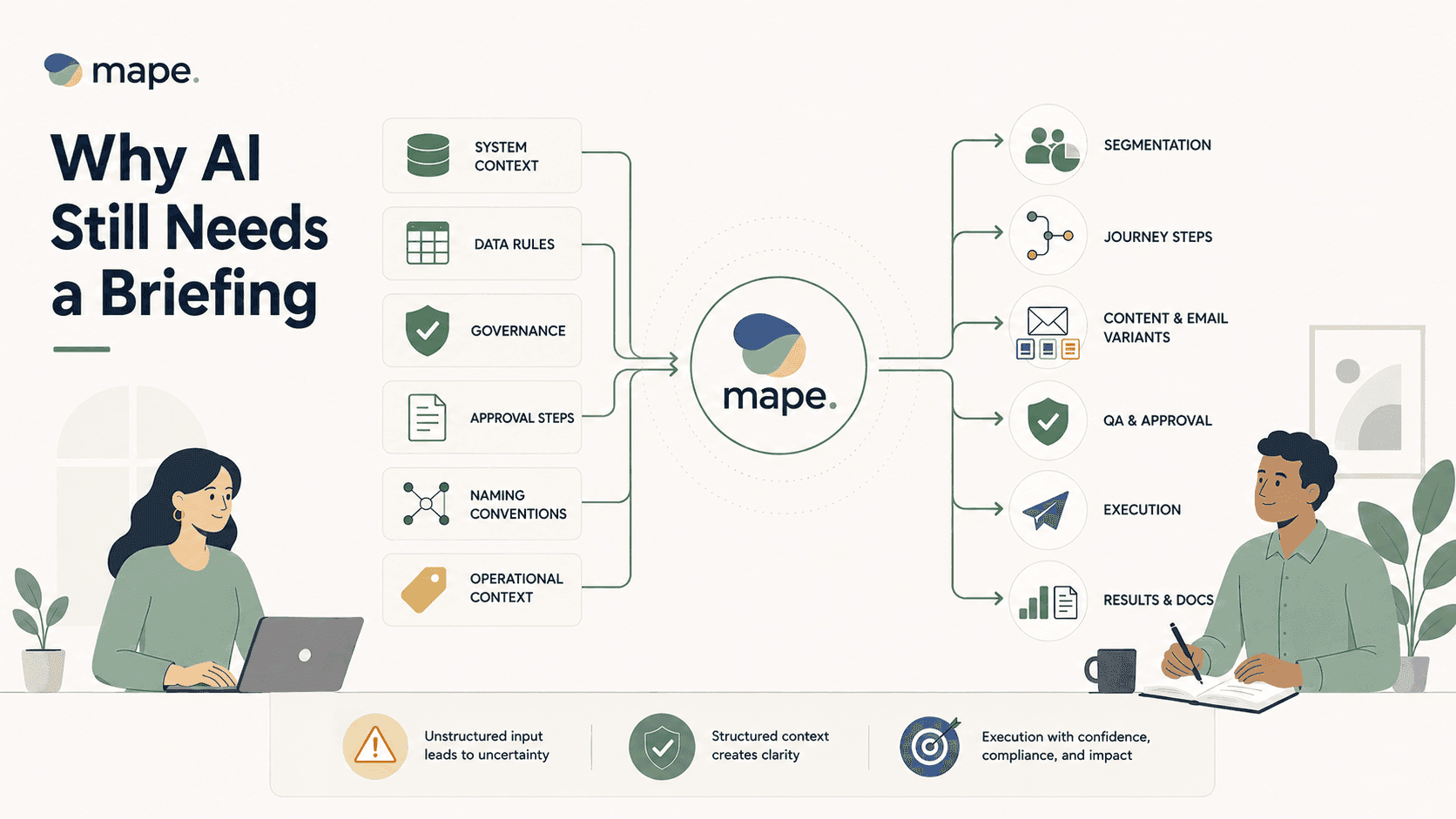
Business intent → discovery → customer context → architecture and guardrails → agent-assisted implementation → evaluation → execution
The expensive middle is compressed. The importance of the decisions around it increases.
Building is becoming easier. Knowing what to build is not.
The strongest general-purpose AI products may be better at general reasoning than any domain application. Modern software builders may be better at generating applications than a specialist CRM product. That is not the point of differentiation.
The important distinction is this:
They make building easier. An expertise layer helps determine what should be built.
| Capability | What it increasingly does well | What still has to be established |
|---|---|---|
| General-purpose AI | Reasoning, drafting, analysis and code generation | Which context is authoritative, which questions matter and what a correct business outcome looks like |
| Software-generation platforms | Turning an expressed intent or specification into working software | Whether the specification reflects the right data, rules, risks and operating model |
| CRM and marketing platforms | Providing governed data, permissions, workflows and transactional execution | Which change the organisation should make and how it should be validated |
| Expertise layer | Applying domain methods, customer context, safeguards and evaluation to the work | Human approval and accountability for consequential decisions |
A model can reason. A builder can create an interface. A CRM can execute a transaction.
None of those capabilities automatically creates the operating methodology connecting them.
Three kinds of knowledge
The debate about whether a general-purpose model can become the expert often combines three different kinds of knowledge.
1. Public knowledge
Consider the question:
How should an abandoned-cart journey generally work?
A frontier model can answer this extremely well. It can explain timing, segmentation, message sequencing, experimentation and common implementation patterns. It may also generate the SQL, scripts, configuration or application code required to execute the idea.
Public domain knowledge is becoming abundant.
2. Organisational context
Now change the question:
How does this company's abandoned-cart process actually work?
The answer may require access to CRM data, a marketing automation platform, commerce systems, consent records, documentation, naming conventions, existing automations and previous campaign decisions.
Headless architectures and MCP make much more of this context accessible to models. Salesforce, HubSpot and Microsoft are all making governed business systems callable by agents.
That is an important advance. But access to context is not the same as understanding which parts of that context are correct.
3. Expert judgment
The third question is harder:
Given everything we have discovered, what should this company change, what should remain untouched, what are we missing and what must be validated before anything goes live?
A customer system is not necessarily a source of truth simply because an agent can read it.
Fields can be stale. Documentation can contradict implementation. Two systems can disagree about the same customer. A naming convention can describe a process the team stopped following years ago.
An experienced practitioner does not simply retrieve context. They interrogate it.
Sometimes their most valuable recommendation is:
Do not build this yet.
A Marketing Cloud example
Imagine a customer asks:
Build a reactivation campaign for customers who have not purchased in 180 days.
A connected agent may inspect the environment and find records or fields for contacts, orders, last purchase date, email consent and journey history.
Technically, it already has significant context.
But an experienced CRM or Marketing Operations practitioner starts asking different questions:
- What exactly counts as a customer?
- Does a refunded order qualify?
- Which system is authoritative for purchase history?
- Is the last-purchase field maintained reliably?
- How are guest-checkout customers represented?
- Does the consent field mean the same thing in every market?
- Does journey history include service communication as well as marketing communication?
- Is another win-back programme already targeting part of the audience?
- How frequently does the commerce source synchronise?
- What happens if somebody purchases between segmentation and send?
- Are there suppression rules outside the obvious CRM objects?
- What happened in previous reactivation campaigns?
- Which answer should be trusted when systems disagree?
A capable model can reason about every one of these questions.
The harder problem is ensuring the right questions are asked in the first place, determining what counts as acceptable evidence, handling contradictions and defining what must be true before the campaign is allowed to launch.
That is the difference between having context and applying expertise.
Can a general-purpose model simply become the expert?
Yes—if an organisation builds the necessary system around it.
A sufficiently determined team can connect a capable model to its CRM and marketing platforms, documentation, campaign history and other business systems. It can add specialist instructions, workflow definitions, approval policies, deterministic checks, evaluation criteria and persistent context.
At that point, however, the organisation has not merely adopted a model.
It has started building and maintaining an expertise system.
This is an important concession because it leads to a more credible competitive position. The choice is not between a supposedly intelligent specialist product and an unintelligent general model. General models are extraordinarily capable and will keep improving.
The choice is between:
building and continuously maintaining a CRM and Marketing Operations expertise system around general-purpose AI, or using one that already provides that operating layer.
The real build-versus-buy decision
Software-generation tools make the distinction even clearer.
Ask a modern builder to create a dashboard showing customers at risk of churn and it may produce an impressive application quickly.
But before that application is useful, somebody still has to determine:
- What does “at risk” mean?
- Which source owns the customer identity?
- What is the churn window?
- How should refunds and missing data be treated?
- Which customers should be excluded?
- Which interventions are appropriate?
- Which permissions apply?
- How is marketing consent handled?
- How should success be measured?
If all of these decisions are already known, software generation becomes dramatically easier.
But something important has happened: the expertise was supplied before the software was generated.
Software builders reduce the need to know how to build an application. They do not remove the need to know what good CRM and Marketing Operations look like.
The build-versus-buy question is therefore not whether the underlying technology can be reproduced. It often can.
The question is whether continuously structuring, evaluating and maintaining domain expertise as software is a capability the customer wants to own.
A three-layer market is emerging
The shift can be understood as three connected layers.
1. The system layer
This is where Salesforce, HubSpot, Dynamics, Braze and other business platforms remain essential.
The system layer owns customer data, identity, permissions, business objects, transactional execution, audit trails and governed business logic.
Going headless does not make this layer irrelevant. It makes its capabilities available to more interfaces.
Salesforce describes the platform as providing identity, access, capabilities, governance and accumulated business context. Microsoft similarly positions Dynamics 365 MCP servers as a governed route through which agents can use the same data models, permissions, business rules and audit trails as other users.
2. The intelligence layer
This layer is supplied by general-purpose models and agent infrastructure.
It provides language understanding, reasoning, generation, planning and tool use. It can translate natural-language intent into analysis, code, queries and actions.
Models at this layer will continue to improve. An expertise product should benefit from that progress rather than depend on permanently outperforming general-purpose models at general reasoning.
But a model does not automatically know why a company's data model was designed a certain way. It does not inherently know which fields are trusted, which exceptions matter, which approval paths are mandatory or which historical decisions must be preserved.
Intelligence can propose and execute. It still needs direction.
3. The expertise layer
The expertise layer connects business intent to governed execution.
It asks:
- What are we actually trying to accomplish?
- Which questions must be resolved before action?
- Which system or evidence should be trusted?
- What does good look like in this domain?
- Which safeguards and approval points apply?
- What must be validated before deployment?
- How does this organisation operate differently from generic best practice?
This layer combines domain methodology, interpreted customer context, guided workflows, validation and human oversight.
An API describes what a system can do.
A model can reason about what it might do.
The expertise layer helps determine what the organisation should do.
Why the CRM vendors are moving in this direction
At first glance, two developments may appear contradictory.
CRM vendors are giving coding and business agents more ability to perform implementation. At the same time, they are telling developers and partners that architecture, domain understanding, system design and judgment are becoming more valuable.
They are not contradictory. They are causally related.
AI becomes better at implementation
↓
Implementation becomes less scarce
↓
Knowing what to implement becomes relatively more valuable
↓
Experts move toward architecture, context and validation
↓
Expertise can increasingly be encoded into repeatable workflows
Salesforce's Consulting Partners Hub makes this explicit. It tells partners to turn domain expertise into competitive advantage and argues that customers often have a context problem rather than merely a data problem. Partners able to architect that trusted context become more important, not less.
HubSpot is opening similar architectural space. Its UI extensions allow developers to build contextual interfaces and guided multi-step workflows on top of HubSpot. Its remote MCP server allows compatible AI tools to read and write permitted CRM data while respecting existing user permissions.
HubSpot's State of Partner AI Readiness reports that 73% of partners are actively embracing AI, 42% prioritise building internal AI skills and expertise, and 30% are already building custom agents. HubSpot's partner message is that firms combining their own expertise with AI capabilities are positioned to capture the opportunity.
Microsoft makes the partner role equally clear. In its description of Dynamics 365 as an agent-ready business applications platform, Microsoft describes business applications moving from systems of record toward systems of action. Agents carry out more work while people set the guardrails. Partners contribute the industry knowledge, domain expertise and customer relationships that translate platform capability into real outcomes.
The vendor evidence points in one direction:
Platform capability is becoming more accessible. Applied expertise is becoming more valuable.
Where mape fits
This is the layer mape is built to provide.
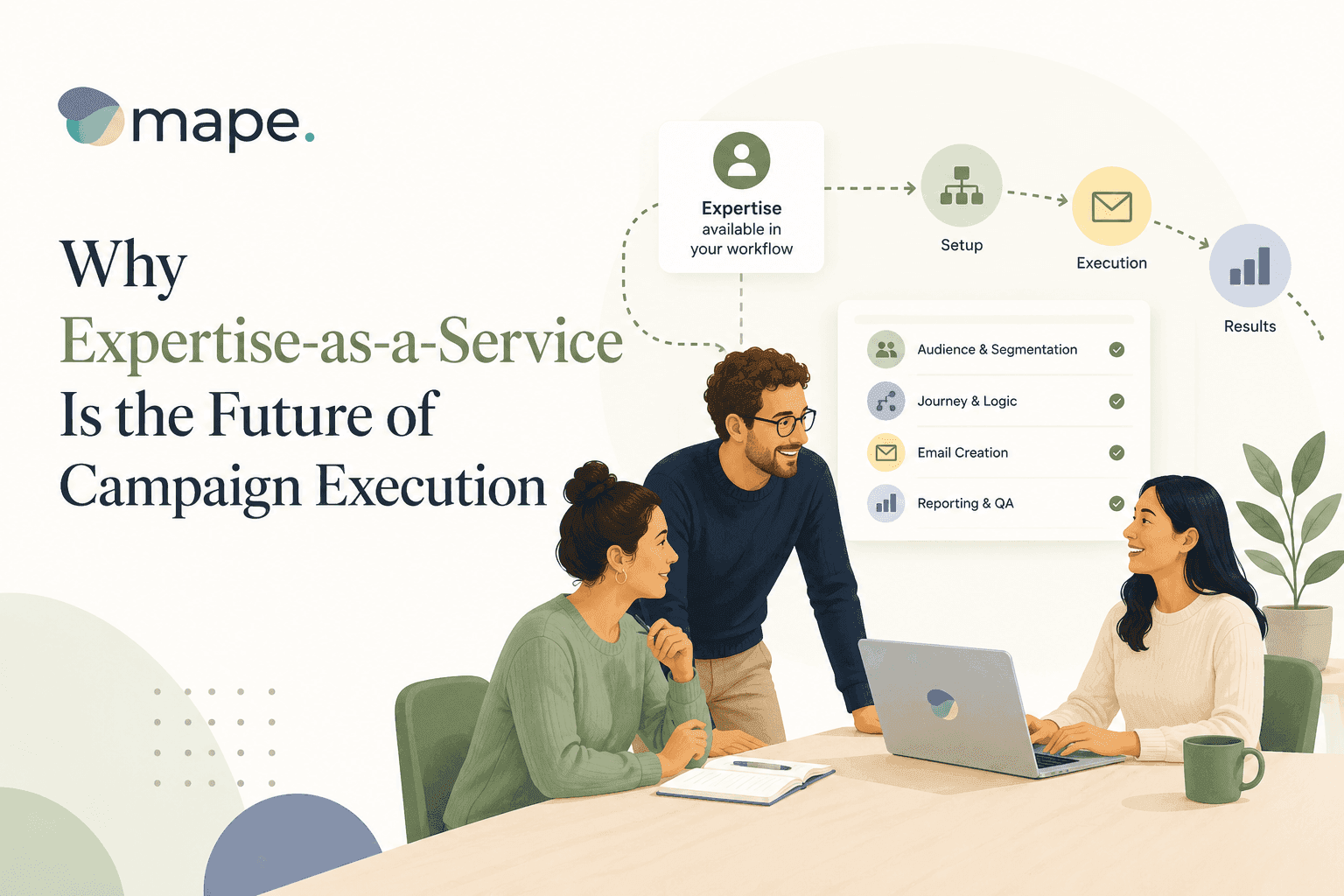
mape is Expertise-as-a-Service for CRM and Marketing Operations. It sits above existing CRM and marketing automation systems and helps teams move from a business situation to guided, contextual and documented execution.
Artificial intelligence can be part of the engine, but it is not the product. The product is the domain expertise that shapes what should be inspected, which questions need to be resolved, how the work should proceed and what must be reviewed before completion.
That distinction matters competitively.
mape does not need to claim that a general-purpose model cannot understand Salesforce. Increasingly, it can.
mape does not need to claim that software builders cannot create impressive applications. Increasingly, they can.
mape's role is to apply CRM and Marketing Operations expertise around those capabilities: business discovery, direct system context, appropriate safeguards, validation, documentation and visible human accountability.
The concise comparison is:
General-purpose AI can understand and reason. Software builders can generate. CRM platforms can govern and execute. mape helps teams decide what should be done, why and under which conditions.
Starting with complex CRM and marketing automation environments, mape focuses on the operational work that repeatedly slows campaign teams down: segmentation, campaign setup, journey logic, email creation, reporting, quality assurance and documentation.
The interface can change. The need for context, judgment and responsible execution remains.
Expertise is becoming software
The headless CRM shift does not make domain experts obsolete.
It changes the economics of what they do.
When implementation required large amounts of specialist manual work, much of the value of expertise was consumed in producing the implementation itself. As agents absorb more of that work, experts can move upward.
They can spend more time understanding the business, interrogating context, designing the operating model, defining guardrails, validating outputs and improving the methodology that guides future execution.
Salesforce's VIBEPASS research shows why that validation matters. Generating plausible code is increasingly easy, but identifying and repairing subtle faults remains considerably harder. The same principle applies to CRM and Marketing Operations: a technically successful workflow can still be wrong for the business.
The strongest expertise organisations will not merely use AI to make individual specialists faster. They will turn professional judgment into systems that make good practice easier to apply consistently.
CRM vendors provide the governed system.
Model providers provide increasingly capable intelligence.
Software builders make implementation dramatically easier.
The remaining strategic layer is the one that understands how those capabilities should be applied to a particular business problem.
Implementation is being commoditised. Expertise is being productised.
That is the shift behind headless CRM.
And that is the layer where mape is positioned.
Sources and further reading
- The Future of the Salesforce Developer in the Agentic AI Era — Salesforce Developers
- What Salesforce Headless 360 Means for Developers — Salesforce Developers
- Salesforce Consulting Partners Hub
- Master the Agentic Development Lifecycle for Agentforce — Salesforce Developers
- VIBEPASS: Can Vibe Coders Really Pass the Vibe Check? — Salesforce AI Research
- Remote HubSpot MCP server is now generally available — HubSpot Developers
- UI extensions overview — HubSpot Developers
- State of Partner AI Readiness — HubSpot
- Microsoft Dynamics 365: An agent-ready business applications platform — Microsoft